Associate Professor Stavros Veresoglou's team取得科研进展
It is a gas lab: A new data synthesis supports that the identities of plant and fungus mainly determine growth benefits of plants associating with ubiquitous soil mutualists.
Mutualistic associations that plant roots form with soil borne fungi of the phylum Glomeromycota, termed arbuscular mycorrhizas (AM), are amongst the most ubiquitous symbioses across terrestrial ecosystems. The benefits that plants gain from the symbiosis depend strongly on environmental parameters, such as light intensity and soil fertility but also reflect how compatible the Glomeromycotan fungus is with the plant species (the mycorrhizal phenotype). Exploring what drives mycorrhizal benefits for the plants can help us harness the power of mycorrhizas for a range of applications in sustainable agriculture, land reclamation and conservation.
The team of the it is a gas lab at the School of Ecology at Sun Yat-sen university with Professor Tien Ming Lee at the School of Ecology at Sun Yat-sen university carried out a quantitative synthesis on subsets of studies from existing meta-analyses showing extreme plant mycorrhizal growth effects.They assessed the degree to which experimental parameters differed between the top-five best and the bottom-five worse performing studies per meta-analysis. They compiled this way a dataset comprising 24 meta-analyses and a total of 240 experimental studies. They subsequently addressed a set of five hypotheses with the aid of logistic regression models (top performing study – 1; bottom performing study – 0).
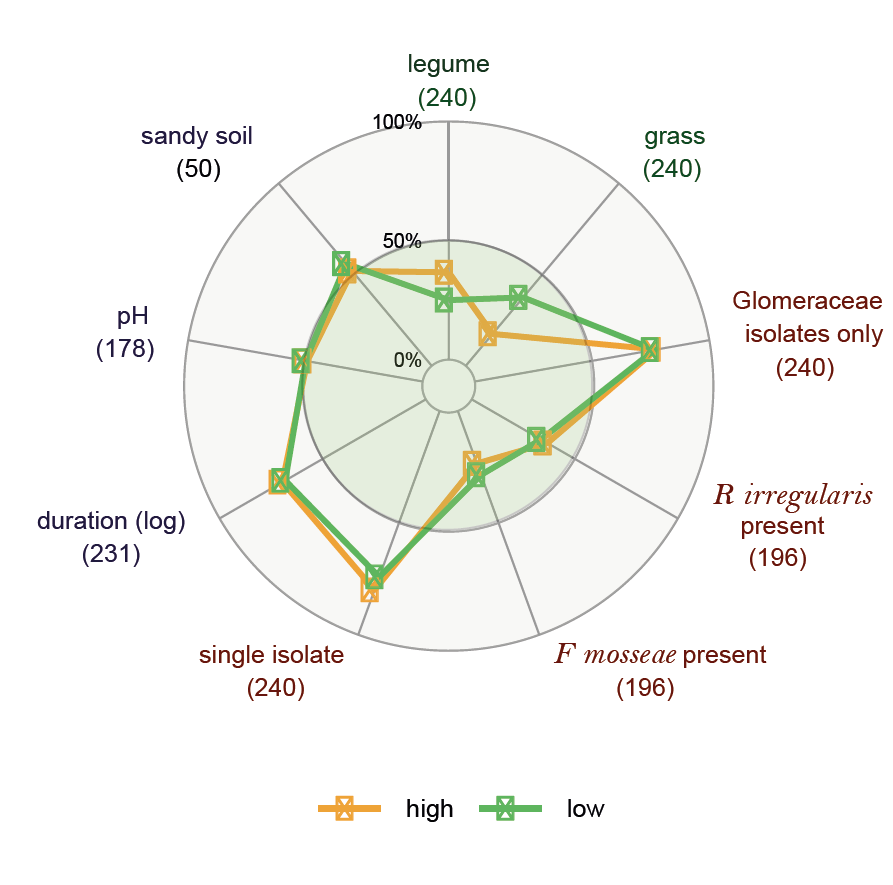
Fig. 1. Radar plot depicting how seven categorical and two continuous experimental parameters differed between top performing (“high”) and bottom performing (“low”) studies across 24 meta-analyses. The categorical predictors described (1) the proportion of studies where a legume had been used as a host plant (legume); (2) the proportion of studies where a grass was used as a host plant (grass); (3) the proportion of studies where the mycorrhizal fungal community comprised exclusively Glomeraceae species (Glomeraceae); (4) the proportion of studies where Rhizophagus irregularis was among the inoculants (R irregularis present); (5) the proportion of studies where Funneliformis mosseae was among the inoculants (F mosseae present); (6) the proportion of studies where the plant was inoculated with a single mycorrhizal fungal species (single isolate); (7) the duration of the study, log transformed, with the value corresponding to 100% being 7 (i.e. 1097 days; duration low); (8) soil pH, with the value corresponding to 100% being 14 (pH) and (9) the proportion of studies that were carried out in sandy soils (sandy soil). We colour coded the predictors so that predictors describing the plant host are in green, predictors describing the arbuscular mycorrhizal fungal community in red and predictors describing abiotic parameters in blue. We report on the number of studies (out of a total of 240 studies) for which we found data for each predictor in parentheses.
To their surprise they observed small differences in abiotic parameters between top and bottom performing studies and these mainly described the identity of the host plant and the mycorrhizal fungus (Fig. 1). There have been numerous meta-analyses in mycorrhizal ecology. Their results, however, are only generalizable for a narrow set of ambient “average” experimental settings. Through expanding the scope of past syntheses to specifically address uncommon experimental settings, the article paves the way for yet more insightful interpretations of existing mycorrhizal studies.
Article Link:
https://nph.onlinelibrary.wiley.com/doi/10.1111/nph.19108
Summary
The article challenges a misconception in mycorrhizal ecology that growth responses to mycorrhiza are mainly determined by abiotic settings, such as soil fertility and experimental duration. At the same time, the article addresses four yet unresolved hypotheses in mycorrhizal ecology.
Members of the it is a gas lab led by Min Wang (王敏), at the School of Ecology at Sun Yat-sen University in collaboration with Professor Tien Ming Lee at the School of Ecology at Sun Yat-sen University have published an article in New Phytologist with the title Context dependent plant responses to arbuscular mycorrhiza mainly reflect biotic experimental settings. Min Wang (王敏) is an MSc student at the it is a gas lab who carried out the data-collection and assisted the writing of the article. School of Ecology of Sun Yat-sen University is the first unit of the paper. Min Wang(王敏) from our school is the first author, and Stavros Veresoglou is the corresponding author.
Lab Advertisement
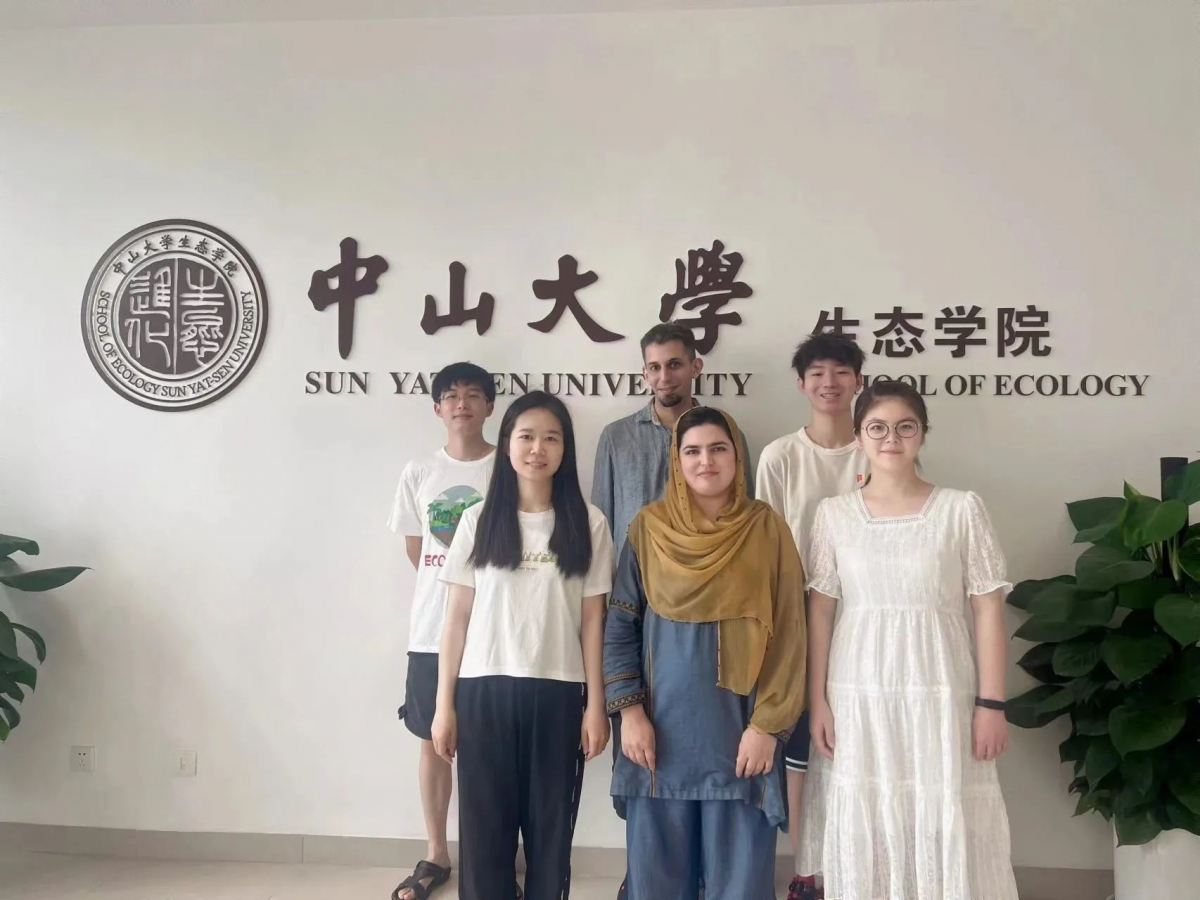
The expression “it is a gas” in English means that something is thoroughly entertaining. In the it is a gas lab, we work on greenhouse gases and we really enjoy ourselves (we are actually equipped with our own gas chromatograph).The focus of the lab is on global change biology and a lot of the ongoing research addresses mycorrhizas, symbiotic associations between the roots of terrestrial plants and fungi. For inquiries to join the lab please contact (inquiries can be in Chinese or in English) Junjiang Chen (陈俊江) at chenjj353@mail2.sysu.edu.cn.