博学大讲堂·相山讲坛预告丨跟随D. Andrew Barry教授探寻大型温带湖泊深水升温机制
大型温带湖泊的深水为何升温?——来自日内瓦湖的研究启示
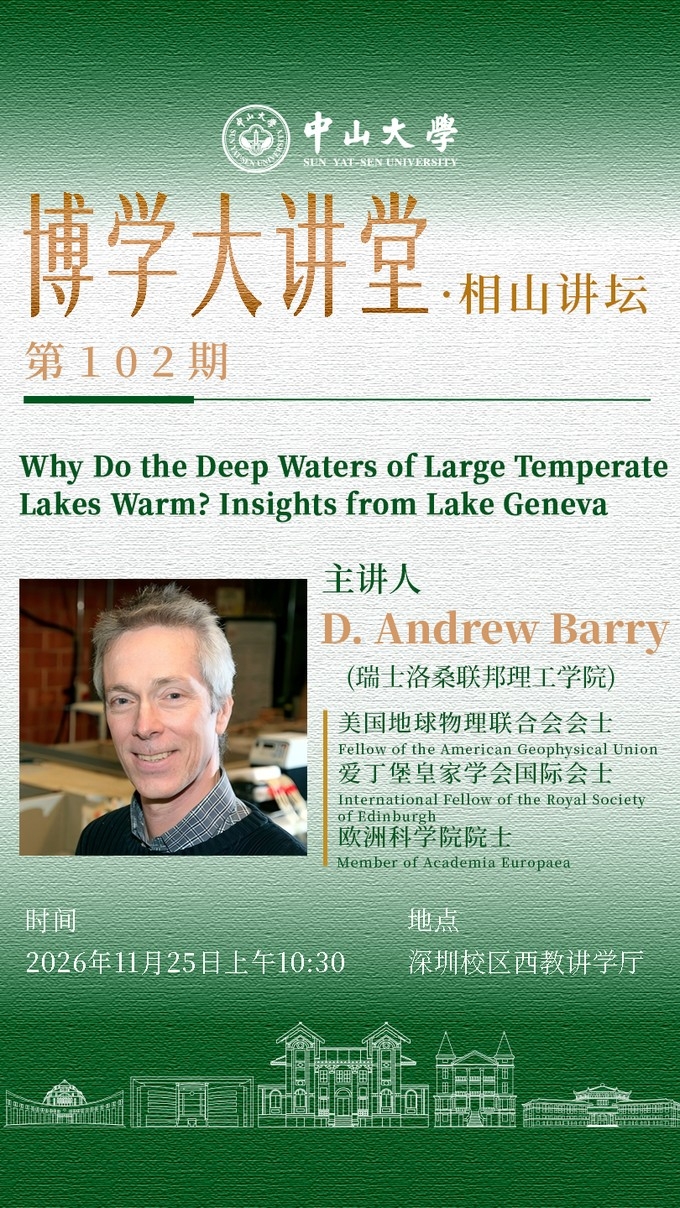
讲座海报
主讲人介绍:
D. Andrew Barry教授为澳大利亚籍学者,曾在澳大利亚、美国、英国和瑞士的多所高校任职。2005年加入洛桑联邦理工学院(EPFL)环境工程研究所并领导生态工程实验室,2023年荣休。现任河海大学客座教授,长期与国内学界开展合作。他的研究领域涉及土壤科学、非饱和带水文学、地表水文学、土壤侵蚀、土壤与地下水污染以及物理湖泊学等方向。因其学术贡献,Barry教授先后当选美国地球物理联合会会士、爱丁堡皇家学会国际会士及欧洲科学院院士。
D. Andrew Barry is an Australian whose career path included academic appointments in Australia, the US, the UK, and Switzerland. He joined EPFL in 2005 and led the Ecological Engineering Laboratory in the Institute of Environmental Engineering until retirement in 2023. He regularly visits China as Visiting Professor at Hohai University. His research fields traverse diverse aspects of environmental science and engineering, including soil science, vadose zone hydrology, surface hydrology, soil erosion, soil and groundwater contamination and physical limnology. His professional contributions have been recognized by different awards, including Fellow of the American Geophysical Union, International Fellow of the Royal Society of Edinburgh, and Member of Academia Europaea.
讲座内容:
湖泊所获的大部分热量均通过气水界面输入。由于温水密度低于冷水,其倾向于滞留于近表层,故表层增温通常优先加热上层水体,而非深层。昼夜及季节性冷却过程驱动近表层水体混合,形成上层混合层;然而在深水湖泊中,该混合层常由温跃层与下部冷水体分隔,从而抑制垂向交换。由此引出一个关键问题:既然热量自表层输入,大型湖泊的底层水体何以升温?本报告以日内瓦湖为研究对象,阐释大型深水温带湖泊中热量再分配的水动力机制。三个相互作用的主控因子至关重要:表层增温与冷却,调控层结及对流;风场驱动水流、上升流及湖盆尺度内部运动;湖盆形态与地球自转则影响上述运动的发展形式。尽管日内瓦湖多呈稳定层结,但其深层水体呈现缓慢升温趋势,间或受突发冷却事件干扰,凸显了垂向交换、浅水区侧向入流、跨湖盆水体更替及内波的重要作用。因此,日内瓦湖为理解气候变化如何影响大型温带湖泊深层水体更新及水质变化提供了典型案例。
Most of the heat entering a lake comes through the air-water interface. Because warm water is less dense than cold water, it tends to remain near the surface, so surface heating usually warms the upper waters first rather than the deepest parts of the lake. Day-night and seasonal cooling mixes this near-surface water and creates an upper mixed layer, but in deep lakes that layer is often separated from the colder deep water by a thermocline, which limits vertical exchange. This raises an important question: If heat enters at the surface, how can the deepest waters of a large lake warm? Using Lake Geneva as an example, this talk explains the hydrodynamic processes that redistribute heat in a large, deep temperate lake. Three interacting controls are central: surface heating and cooling, which affect stratification and convection; wind, which drives currents, upwelling, and basin-scale internal motions; and basin shape and Earth's rotation, which influence how these motions develop. Although Lake Geneva is usually stably stratified, its deepest waters show gradual warming interrupted by occasional cooling events, revealing the importance of vertical exchange, lateral inflows from shallower regions, interbasin renewal, and internal waves. Lake Geneva therefore provides a clear example of how climate change can alter deep-water renewal and water quality in large temperate lakes.
主办单位:党委宣传部 深圳校区管委会 生态学院